
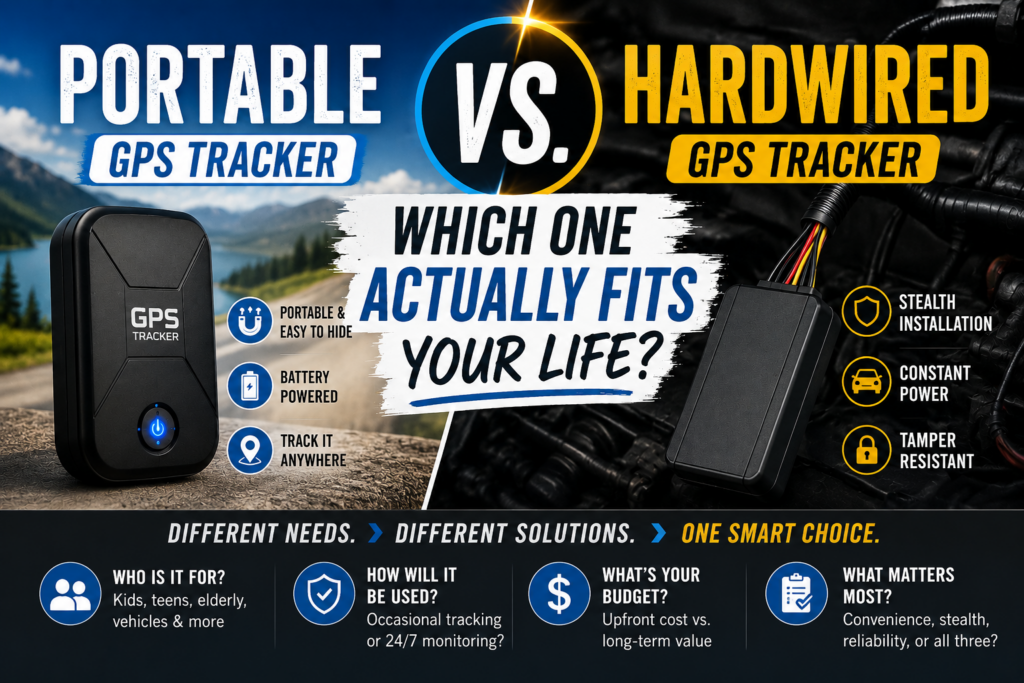
GPS trackers have gone from niche spy-movie gadgets to everyday essentials – and for good reason. Whether you’re protecting a vehicle, keeping tabs on a family member’s car, or just tired of wondering where your stuff is, a GPS tracker solves the problem fast.
But here’s where most buyers get stuck: portable or hardwired?
Both track location. Both connect to your phone. But under the hood, they work very differently – and picking the wrong type means paying for features you’ll never use (or missing the ones you actually need).
Let’s break it down.
The Quick Version
- Portable GPS tracker – battery-powered, no installation, flexible, needs charging
- Hardwired GPS tracker – wired into a vehicle’s power, always on, tamper-resistant, permanent
Still here? Good. Here’s what that actually means in practice.
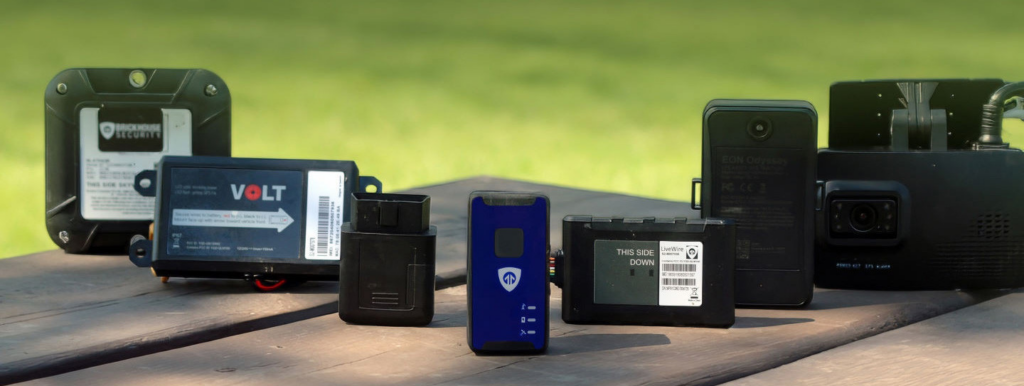
Portable GPS Trackers: Maximum Flexibility, Minimum Fuss
A portable tracker is a self-contained unit – GPS chip, cellular radio, and battery all in one compact device. You charge it, place it wherever you need it, and it starts transmitting location data to your app.
No tools. No wiring. No electrician. Some of the best ones are barely bigger than a matchbox.
Where they shine:
- Slipping into a backpack, laptop bag, or piece of luggage before a trip
- Tracking a vehicle you don’t own or can’t modify
- Monitoring multiple assets with one device – rotate it between your car, your kid’s bike, your storage unit
- Getting up and running in under five minutes
The one real trade-off: battery life.
This is the thing no one talks about enough. A portable tracker on aggressive real-time mode (updating every minute) can drain in 2-3 days. Set it to update every 15-30 minutes and you might get 2-4 weeks. Some ultra-low-power models in deep sleep mode claim months of standby – but at that point, you’re not really tracking in real time anymore.
For travelers using a tracker in luggage or a rental car, this is perfectly fine. For permanent vehicle monitoring? It gets tedious fast.
Hardwired GPS Trackers: Set It, Forget It, Never Charge It Again
A hardwired tracker taps directly into your vehicle’s electrical system. Most connect to the OBD-II port (the diagnostic plug under your steering wheel – takes about 30 seconds). At the same time, traditional hardwired installs go behind the dashboard for a cleaner, more discreet setup.
Because it runs off the car’s power, the battery conversation is over. It’s always on. Always reporting. Always there.
Where they shine:
- Permanent installation on a vehicle you own
- Real-time tracking that actually means real time – some update every 10-30 seconds
- Tamper detection: many send an instant alert if someone tries to unplug or remove the device
- Fleet or multi-vehicle management where reliability is non-negotiable
The one real trade-off: commitment.
A hardwired tracker is married to that vehicle. You can’t move it to your luggage before a flight or drop it in your kid’s backpack. And while OBD-II plug-in versions are genuinely easy, a behind-the-dash install requires some know-how (or a quick trip to a shop).
Head-to-Head: What Actually Matters
Installation Time
- Portable: 0 minutes. Charge and place.
- Hardwired (OBD-II): 1 minute. Plug under the dash.
- Hardwired (traditional): 30-60 minutes, tools required.
Winner: Portable – but OBD-II hardwired is close.
Real-Time Accuracy
Here’s the honest answer: hardwired trackers win this one and it’s not close.
Without battery constraints, a hardwired device can ping location every 10-30 seconds all day, every day. A portable tracker has to balance accuracy against battery life – you’re usually choosing between frequent updates (short battery) or long battery (less frequent updates).
For vehicle tracking where you want to know your teen’s exact route, or catch a stolen car as it moves, that update frequency gap is significant.
Winner: Hardwired
Tamper Resistance
A magnetic portable tracker attached under a bumper is findable – physically or with a cheap RF detector. Someone who wants to remove it probably can.
A hardwired tracker hidden behind dashboard panels with no visible wires is a different story entirely. Add tamper alerts and you get a notification the moment someone messes with it.
Winner: Hardwired
Flexibility
One portable tracker can cover your car on Monday, your partner’s bag on Tuesday, and a rented motorcycle in Bali on Saturday. Hardwired devices can’t do any of that.
Winner: Portable – by a landslide
Cost
Portable trackers typically run $30-$80 upfront. Hardwired OBD-II devices are similar ($60-$120). Traditional hardwired installs add $50-$100 for professional installation.
Both types usually require a monthly cellular data plan – expect $15-$30/month. Look for no-contract options so you’re not locked in for a year if your needs change.
Winner: Roughly equal – portable has a slight edge on upfront cost
Which Type Is Right for You?
Go portable if:
- You travel frequently and want to track bags, rental cars, or borrowed vehicles
- You need one device that moves between multiple assets
- You want zero-install simplicity
- Battery management doesn’t bother you
Go hardwired if:
- You’re permanently tracking a vehicle you own
- You want real-time updates without compromise
- You need tamper alerts and a device that can’t just be pulled off
- You’re done thinking about charging
A Note on Monthly Fees
One question that comes up constantly: can you get GPS tracking with no monthly fee?
True real-time cellular GPS tracking almost always requires a monthly plan – the network used to transmit location data has an ongoing cost. However, Bluetooth-only trackers (like AirTags) work without a subscription but don’t give you real-time GPS – they rely on other devices nearby to update the location, which is hit or miss.
If you need real-time tracking, budget for a monthly plan. Just make sure it’s month-to-month, not locked to an annual contract.
The Bottom Line
Neither type is universally better. They’re tools built for different jobs.
Travelers, adventurers, and people who need tracking flexibility across multiple items should start with portable. Vehicle owners who want reliable, always-on, tamper-resistant tracking should go hardwired.
And if you’re already tracking your luggage or gear with a GPS device, you’re ahead of most people – the tech has never been smaller, smarter, or more affordable. For a closer look at how portable GPS tracking works in a travel context, check out this deep-dive on GPS luggage trackers for Android – a great starting point for anyone new to tracking their gear on the go.
The best GPS tracker is the one you actually use. Pick the type that fits your life and set it up today.